
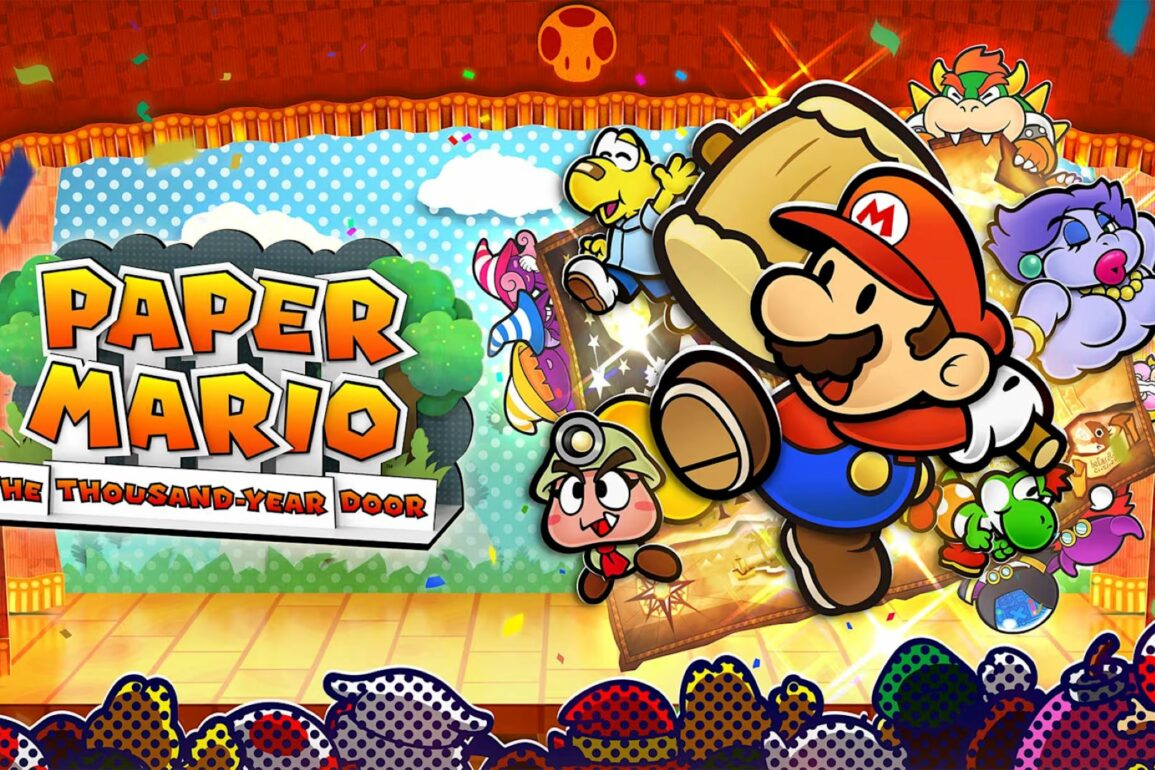
The Paper Mario series has always caught my eye from a young age. It has a unique style and attitude compared to most other Mario games, and it certainly has captivating gameplay. Unfortunately, so far, the only Paper Mario experience I have is with the 2007 Wii game Super Paper Mario. Thankfully, Paper Mario: The Thousand-Year Door is here to change that. In fact, it has been so good that I can’t wait to dive into the rest.
“Paper Mario: The Thousand-Year Door offers players a unique Mario experience that is a lot of fun from start to finish.”
Paper Mario: The Thousand-Year Door opens with Mario receiving a letter from Princess Peach. The letter includes a map leading to seven Crystal Stars that open the famous Thousand-Year Door under Roguesport. However, unsurprisingly, Princess Peach is kidnapped again. This time, it isn’t Bowser but a new antagonist, Sir Grodus—a powerful enemy who wants to open the Thousand-Year Door for personal gain. You must journey to collect the Crystal Stars, stop Sir Grodus from opening the Thousand-Year Door, and save Princess Peach.
Throughout your adventure, you’ll encounter new enemies, fun NPCs, and even quirky companions who will join your party. You’ll also get to play as both Peach and Bowser at the end of each chapter. This allows you to see how their stories unfold.

It’s great to see that the original amazing story has been kept intact, offering players a unique Mario experience that is a lot of fun from start to finish. There’s plenty of good humor, nuance, and excitement to be had across the 30+ hour runtime. While it is a fairly simple story with quirky characters, there are enough unexpected twists and turns to keep you on your toes. It’s fair to say that if you loved the original, it’s more of the same, but newcomers will find plenty to love.
Unfortunately, Paper Mario: The Thousand-Year Door provides minimal accessibility options. The only options available in the settings are brightness and rumble changes. This is frustrating as it limits the number of people who can experience the fun-loving remake Nintendo has brought back to life.
“I found that the bosses in Paper Mario: The Thousand-Year Door were the highlight of combat.”
The gameplay in Paper Mario: The Thousand-Year Door is split between turn-based combat on an interactive stage, where you’ll be required to make time-based moves with Mario and his partner, and exploration. In combat, each character has their own skill set, which is expandable through upgrades, that require you to do different time-based mini-games to use. This could include holding down A and releasing it at a specific time, pressing A when you see indications, and much more. This interactive gameplay keeps Paper Mario: The Thousand-Year Door interesting as you’re not simply selecting a move but helping the characters themselves to achieve it.
When on stage, you’ll also need to watch out for the enemy’s moves, audience members throwing items at you, and even using your own. The backgrounds used on the stage are also interactive and can even fall on enemies. Of course, you’ll need to watch out for yourself, too, as the same can be done to you. However, I found that the bosses in Paper Mario: The Thousand-Year Door were the highlight of combat. Each boss is unique and offers a great degree of challenge that makes you use everything you’ve got.

In addition to combat, you’ll also need to solve various puzzles as you explore the world. These often require you to use your partners, as their special abilities can help you overcome obstacles. Unfortunately, there is a lot of back and forth that can become boring and repetitive at times, as you’ll often see the same landscapes and fight the same enemies. Additionally, some of Paper Mario: The Thousand-Year Door’s puzzles may confuse players. While most are fairly easy to solve, there were a few that stumped me no matter how many times I asked Goombella what I must do to progress.
“This, at all times, feels like a fresh new experience, one that is both visually, mechanically, and technically excellent.”
Visually, Paper Mario: The Thousand-Year Door is immaculate. It features beautiful landscapes that help make each world feel all the more immersive. Its unique art style holds up, even after all these years, and the character designs are some of the series’ best. Boggly Woods and The Great Tree were my favorite places to explore. It had beautiful rainbow kaleidoscopic-like visuals, a lovely soundtrack, and quirky characters named Punies.
Paper Mario: The Thousand-Year Door also features engaging visuals that play with depth. To progress in some locations, you’ll need to think outside the box and examine the 2D background behind Mario. You’ll actually be able to go through a pipe and find yourself in the background. I found this to be one of my favorite features during my playthrough, as it was something I was not expecting.

Worlds and levels also feature new enemies and known enemies such as Goombas and Koopas; however, they are reimagined visually. This also surprised me throughout my playthrough, as I found enemies I had never heard of and ones I did know but were visually different. It was a fantastic choice for Nintendo to feature such a wide variety of enemies. It prevents things from getting stale, and the visual variety ensures you’re always aware of the level of difficulty each enemy poses.
Despite being a remake of a GameCube game, visually, it did not feel like it. This, at all times, feels like a fresh new experience, one that is both visually, mechanically, and technically excellent. I needed to keep reminding myself that it was a remake and not a brand-new game.
“Although the soundtrack has been reinvented for the remake, the original soundtrack is available”
Paper Mario: The Thousand-Year Door features a playful soundtrack that compliments the style and quirkiness of its story. In each world, you’ll listen to a fresh new soundtrack that perfectly fits with the environment and stage you’re in. Once again, Boggly Woods and The Great Tree had the best music, as they featured unique sounds that fit their iridescent visuals. Additionally, although the soundtrack has been fully rescored for the remake, you can also switch to the original soundtrack.
Sound effects also play a significant part in Paper Mario: The Thousand-Year Door. They help convey certain emotions the characters were feeling and aid you in executing moves when fighting enemies. Audio cues would sometimes help you during puzzles. However, they were mainly used to express how vital or silly a situation was in the story.

“Paper Mario: The Thousand-Year Door was the GameCube classic remake we were waiting for”
Paper Mario: The Thousand-Year Door was the GameCube classic remake we were waiting for. It reawakened a classic experience and placed it on a current console, allowing new and returning players to dive into a captivating, quirky story. Whether this story is new or nostalgic to you, you’ll be quickly drawn in and won’t put it down till the credits roll.
It provides a hilarious story for all ages to enjoy, where you’ll learn to master moves, meet new characters, understand what the Crystal Stars are capable of, and, most importantly, save Princess Peach. Now the question is, will the other Paper Mario games be returning? If they do, I hope they’re just as good as this incredible remake of Paper Mario: The Thousand-Year Door.
Disclosure: Game Crater was provided the game for this review.

Leave a Reply